TI Automotive Polymer ML is the applied AI case study behind my current positioning: not a pure research pitch, but a software-and-modeling problem around messy industrial data, domain constraints, and a workflow useful to lab technicians.
The Problem
The team needed a way to answer an inverse materials question: given target properties from an OEM spec, what polymer blend might produce them?
The dataset was small, sparse, and noisy: roughly 500 recipes, 50+ ingredients, missing lab measurements, and plant-level process variance. A generic model architecture was not enough. The useful work was in shaping the data, encoding domain knowledge from subject matter experts, and building a modeling loop that respected the physical constraints of the problem.
System Shape
- Built a forward model that predicts polymer properties from candidate recipes.
- Reduced false correlations with null augmentation for passive materials like colorants and stabilizers.
- Grouped ingredients with SME guidance instead of relying only on clustering.
- Encoded physics features for melt flow rate, where naive averages fail.
- Compared neural architectures, masking missing targets instead of imputing lab measurements.
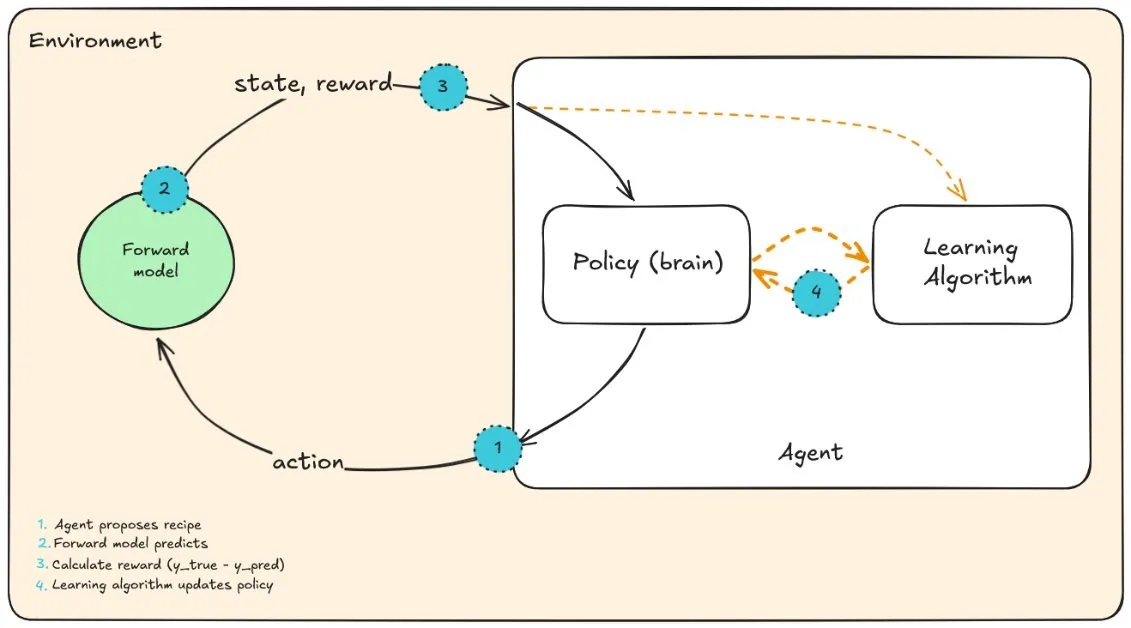
- Used the forward model as the environment for model-based inverse search.
Result
The clearest gain came from domain features, not a bigger model. Melt flow rate moved from about R2 = 0.43 to R2 = 0.92 after adding the SME-provided physics features. Across the project, the lesson was practical: applied AI work is often a systems problem first and a model-choice problem second.
I wrote the public technical narrative here:
What This Proves
This is the kind of work I want more of: applied AI systems where backend engineering, product constraints, data quality, model behavior, and domain expertise all matter at the same time.